
contextual practice
contextual practice - 4th november
To begin the Interact project we were introduced to the many ways and concepts of "interaction" and what it means in a design context. After being assigned into pairs, we chose the quote randomly from a box which would be the starting point and catalyst for our Interact project. 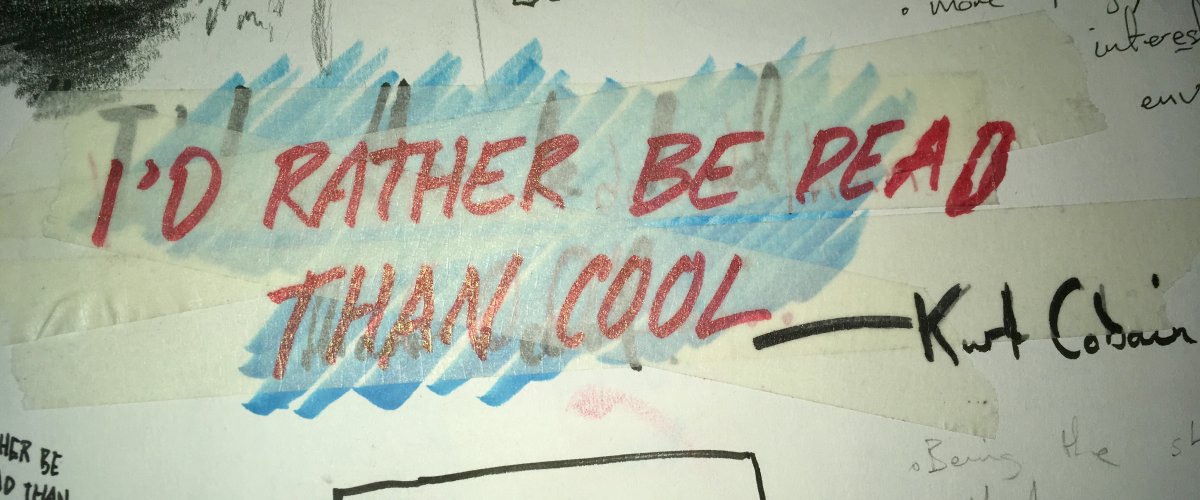
"I'd rather be dead than cool" was the quote from the famous musician Kurt Cobain from the grunge band Nirvana. Coincidentally I am a fan of Nirvana and already knew the source of the quote and some context which made generating ideas slightly easier. Our interpretation of the quote was being "dead" was more liberating and freeing than being "cool" which might mean fitting into society's confines of what it means to be popular and likable or Cool. Knowing a bit of context on Cobain and his struggles with being in the public eye and the media's attempts to water down the music and messages of Nirvana, we thought about what it meant to truly be "cool" and to be "fake cool".
So the idea of fitting people into shapes and manipulating their images was a concept I came up with. We decided to get a sheet of mirrored card, and asked people to pose in the mirror where we would bend and distort the reflected images of people, being a metaphor for how people can be easily changed and influenced by society to fit into the confines of being "fake cool"
contextual practice - 5th november
After me and my partner pitched our idea to the tutor and another group, we received some useful feedback on how to improve and develop the interaction. One comment suggested that we add some sort of frame onto the mirror, in order to allow space to write any messages relating to our theme like "fake cool?" and other things like that. Another suggestion was taking the mirror to somewhere heavily populated and adding a playful element to it which might make it more engaging.
contextual practice - 6th november
We pitched the idea and explained what our interaction was going to be to the rest of the students. The interaction will begin with making the wavy and bendable mirror and decorating it with messages and words. We will take this into a public park and ask people if they would like to participate by standing in front of the mirror, distorting their reflections while we record photos and videos. The messages and sentences that we write onto the mirror will relate back to the original quote or represent our interpretation of the quote and its meaning.
Some of the one's I came up with were
-
would you rather be dead or cool?
-
are you fake cool?
-
wanna be cool?
-
what is your cool form?
-
let's make you cool
-
find your cool shape
-
distortion is the new cool.
Add comment
Details
the mirror
contextual practice - 9th november
Today me and my partner worked on actually constructing the frame idea. We settled on using corrugated cardboard for the first frame, and on it we would write the phrases that we made. We also decided to make multiple frames with different designs and interchange them for more varied results.
research
Chris O'Shea
Average face is a permanent exhibit in London where software would scan the points of people's faces and the system will match somebody who looks technically similar. Then the user is shown a computer generated face that it meant to portray the "average face" and how they compare. The aim of this exhibit was to question "what is means to be human". I think this project is really engaging because of how immersive and in depth it is in terms of technology and precision which probably contributed to its success. The futuristic elements of this exhibition that took place in 2007 definitely makes it memorable for the advancement it showcased.
Kurt Cobain
Kin Design
Kin design is a London based interaction design practice that mainly focuses on technology. Their research aims to make connections between people, information, spaces and things.
One of their commissioned pieces Think, was an interactive space that would display data from visitors of the Nation Maritime Museum in Greenwich. It also had an environmentalist aspect where the interaction would ask questions about climate change and plastic in the ocean.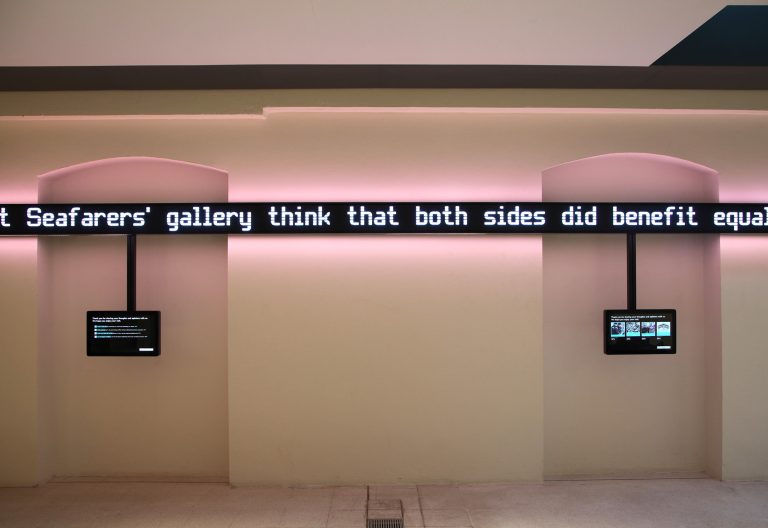
A ten metre long LED screen, would roll statistics and facts about the museum styled like a news headline, that would be interrupted by a wave animation when the visitors entered information on the screens below.
The unavoidable size of the interaction definitely grabs people's attention which I think added to its overall success and encouraged people to engage. Any interaction that asks information from the user is something that will be memorable I think, as the user might feel like they matter and are significant in some way. For example, the wave on the LED screen is caused by their actions, and this instant result is something that will always intrigue or satisfy curious museum goers.
Troika
Glitches
final outcomes